What Happens When You Design a Workplace Around Humans?
People People
Updated on
June 26, 2026
by
Taryn Hart

X min
People People
Updated on
June 26, 2026
by
Taryn Hart
X min
We sat down with Hillary Van Moorleghem of Storycraft Lab for our People People series, and she put it simply: you cannot scale without the human factor.
When organizations design for the human factor, the numbers follow: higher retention, lower burnout, and real ROI.
Recognition isn't a byproduct of belonging. According to the Wheel of Belonging framework, it's one of the eight pathways that gets you there — and Deloitte's latest data shows that 47% of workers cite lack of recognition as a top driver of stress. Here's what it looks like when organizations actually get this right.
This is a question that came up mid-conversation with Hillary Van Moorleghem, Empathy Tech Executive at Storycraft Lab, during a recent People People interview. And the more we sat with it, the more it felt like exactly the right thing to ask.
Not "what is the future of work?" Not "how do we optimize employee engagement?" Just: what does this concept look like on a regular Tuesday?
That specificity is the point. Because the regenerative workplace — a phrase that sounds abstract until it doesn't — isn't a policy or a perks package. It's what happens when organizations stop treating people like machines and start designing for what they are: organic, human, and in need of connection to do their best work.
Hillary borrows the term from ecology and supply chain management — industries where regenerative models are well established. Apply it to our workplaces, and the idea is similar:
👉 A system where investment in people creates a return that feeds back into the organization, rather than extracting from it.
It's the difference between a company that runs its people down until they leave, and one that creates conditions where people want to stay, grow, and contribute.
Circular. Self-sustaining. Better for everyone.
People are an asset that compounds, not depreciates. When organizations design systems that actually account for that, something shifts.
Latesha Byrd, CEO of Perfeqta, confirms this too:
“Culture regeneration doesn't take away from business growth, it protects it. When we design environments that intentionally restore people, everyone wins.”
Here's the case Hillary makes — and it's backed by Storycraft Lab's research, which is rooted in behavioral science and validated across enterprise clients, including Fortune 50 companies.
When people feel seen and recognized at work:
And it goes beyond individual performance. Hillary's argument is that nothing in business scales sustainably without the human factor built in. Innovation, productivity, revenue growth — all of them hit a ceiling and eventually drop, when they're not designed around real human needs.
The inverse is equally true. An organization of 10,000 people that designs for belonging saves $52 million annually. That's not a culture talking point. That's a budget conversation.
The human side of work has historically been invisible. Hard to measure, easy for leadership to dismiss, because there was nothing concrete to show them.
A specific category of technology designed to surface, measure, and act on the human experience at work. Things like belonging, connection, and recognition. Proactively supporting this aspect of the workplace instead of leaving it to chance.
The tool itself: software built to reveal things that used to live only in gut feeling, like a quiz that shows how someone prefers to connect, or a platform where people can openly recognize each other.
And then there's empathy in technology: the design philosophy that determines whether a tool feels human or hollow. You can build a product that technically measures belonging and still misses the point entirely if it wasn't built around how people actually behave.
At the center of Storycraft Lab's work is a framework called the Wheel of Belonging. Developed through research into how people experience and describe belonging, it maps eight pathways people travel toward feeling like they fit:
The data beyond Storycraft Lab's research makes the same argument. Deloitte's 2026 Gen Z and Millennial Survey found that lack of recognition is the #2 driver of job-related stress for both Gen Z and Millennial workers, second only to long working hours, and cited by 47% of respondents in both generations.
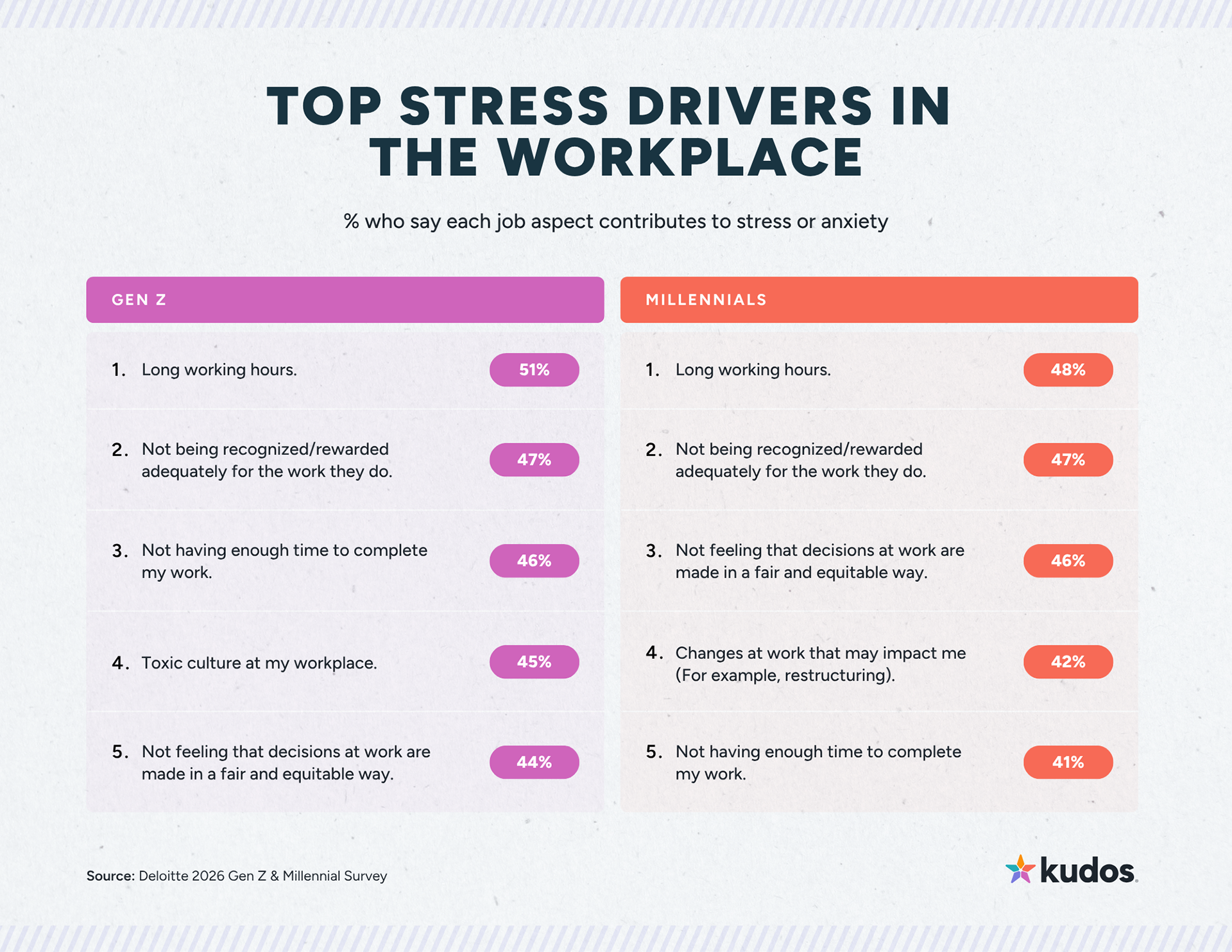
That's not a soft finding buried in a culture chapter. That's one of the world's largest workforce research studies telling HR leaders that the absence of being seen and valued is actively burning people out.
And it means any organization serious about designing a regenerative workplace needs to think carefully about how recognition shows up — not as an annual award or a reactive moment, but as something ongoing and embedded in how work gets done.
Make-A-Wish Foundation® of America offers one of the clearest pictures of what ongoing, embedded recognition produces in practice.
Rather than treating recognition as a standalone HR program, Make-A-Wish built Kudos into how employees experience culture every day: leadership spotlights in monthly all-staff meetings, values-tied recognition, milestone celebrations, and a "sticky recognition" philosophy that encourages quality over speed.
The results are measurable:
These details are worth sitting with. An organization actively moves the needle on one of Deloitte's top two burnout drivers — and it shows up in the data.
As Halie Purdy, National Director of Platform Optimization and People Experience at Make-A-Wish America, put it: employees consistently cite the culture of recognition and the opportunities for connection as top reasons for staying.
That's what belonging looks like when it's designed for, rather than hoped for.
📓Read the full Make-A-Wish case study
When you design for people, the numbers follow. Productivity. Retention. Innovation. And the organizations that are seeing that return are the ones who started treating people as an asset worth investing in, repeatedly, not just in a moment.
👉 Hillary’s practical advice for HR leaders who want to start this week:
Benchmark something. Pick one or two KPIs that leadership cares about — retention rate, PTO usage, time to hire, contract closure — and document where they are right now. That number becomes your proof case. It's what lets you walk into a budget conversation later and say: here's what changed, and here's exactly why.
Make-A-Wish did exactly that. The data was already there. They just built a system that made it visible with Kudos’ help.
That's what a regenerative workplace looks like on a Tuesday afternoon. Not a dramatic overhaul — a shift in what gets measured, what gets seen, and who feels it.


Building a Winning Talent Strategy Through Irresistible Culture
Get Your Guide