Deloitte's 2026 Gen Z and Millennial Survey: 8 Takeaways for HR Leaders
Recognition
Updated on
June 3, 2026
by
Taryn Hart

X min
Recognition
Updated on
June 3, 2026
by
Taryn Hart
X min
22,595 workers. 44 countries. 8 chapters.
Deloitte’s 2026 Gen Z and Millennial Survey revealed this generation is financially pressured but optimistic, ambitious but unwilling to lead at the cost of their health and adapting to AI faster than their organizations can support.
But there’s one finding HR leaders need to act on immediately: the second leading cause of burnout isn’t workload. It’s “not being recognized enough.”
In 2026, that’s a shocking and disappointing reality.
This blog breaks down all eight chapters of the report and connects the data to what HR leaders and people managers can do about it — starting with recognition.
Every year, Deloitte releases one of the most important workforce research documents in the world. Now in its 15th year, the 2026 Gen Z and Millennial Survey captured the experiences of 22,595 respondents across 44 countries — and this year's findings are more urgent, more nuanced, and more directly relevant to people leaders than any previous edition.
The report's theme — "Progress on Their Own Terms" — says everything you need to know about the mindset shift underway. These generations aren't disengaged. They're deliberate in when and why they choose to engage.
They've come of age through repeated disruption, and they're responding by making smarter, more selective decisions about where they work, how they grow, and what they're willing to give.
For HR leaders, this report is a roadmap. Here’s what it says and what it means for how you build culture, retain people, and show up for the 54% of your workforce this generation represents right now.
This is where the report becomes directly, urgently relevant to anyone building a recognition strategy. And it deserves to be read carefully.
The survey asked respondents which aspects of their job contribute most to their feelings of anxiety and stress. The results from Chapter 5, "Well-being as Infrastructure", are striking:
Lack of recognition is the #2 driver of job-related stress for both generations.
Not toxic culture. Not unrealistic expectations. Not difficult colleagues. The absence of being seen and valued for the work they do. That’s not just us saying that. That’s one of the Big Four saying that.
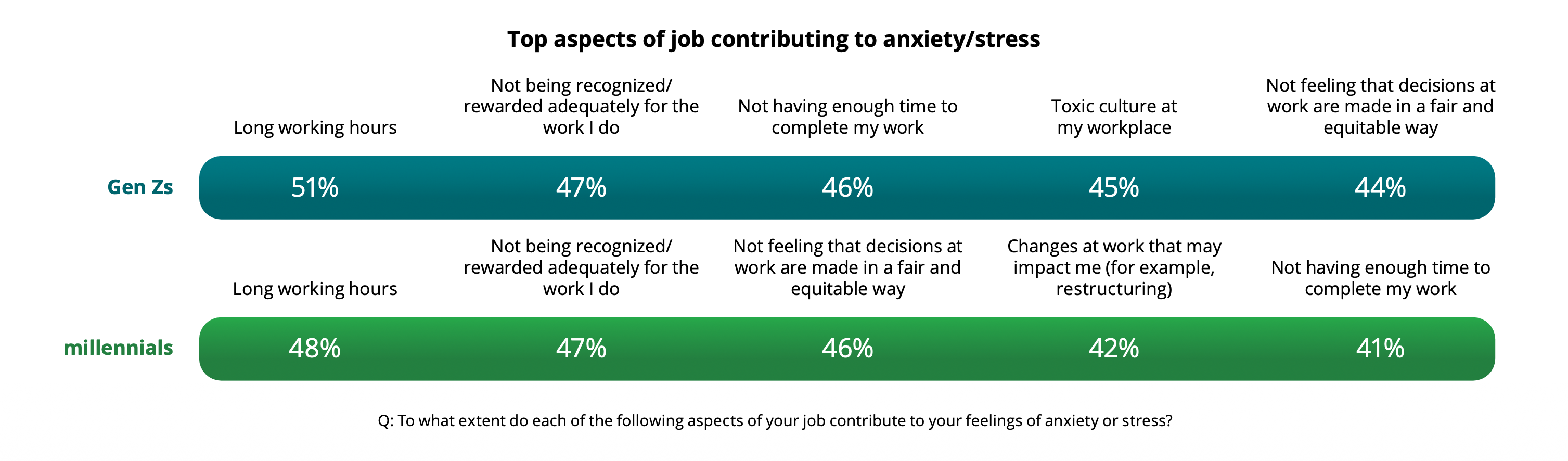
And this sits within a broader picture of persistent pressure: nearly half of Gen Zs (48%) and Millennials (45%) say they feel burned out. Roughly one-third still report feeling anxious or stressed most or all of the time.
Digital overload compounds this. Nearly 60% of Gen Zs and 54% of Millennials report experiencing digital fatigue — overwhelmed by constant alerts, tool switching, and multiple platforms simultaneously.
Tomoko Adachi, CHRO of Terumo Corporation, put it clearly in the report: "This is an area where older generations may have learned to adapt and live with high levels of stress and long working hours, but voices of younger generations are really triggering us to change."
Recognition is one of the most direct levers available to reduce that structural stress. As Kudos’ own research into the science behind employee recognition explains: Receiving genuine appreciation triggers the release of dopamine and serotonin, activating the brain's reward center and creating a "gratitude circuit" that directly increases motivational thought patterns over time.
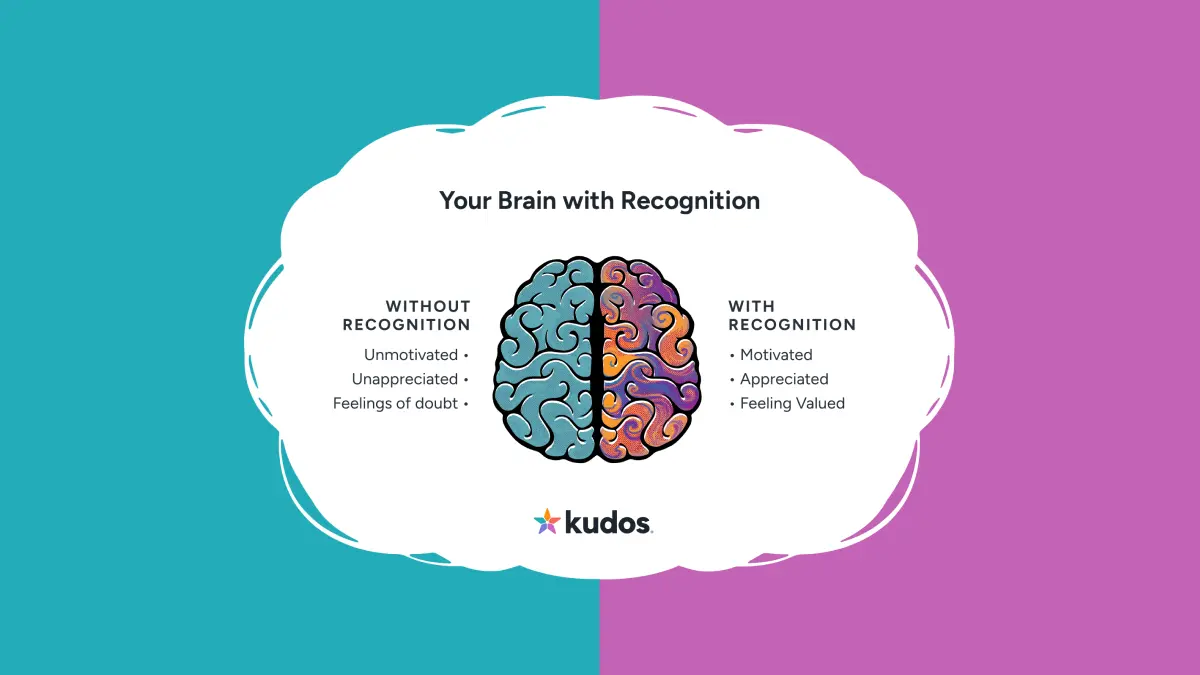
More recognition means a more motivated, more resilient brain state. For a generation already carrying significant financial and work-related stress, that neurological effect is not incidental. It's load bearing.
Progress on well-being is also dependent on psychological safety, and recognition plays a direct role there too.
As Emma Codd, Deloitte's Global Inclusion Leader, noted in the report: "When managers are equipped to respond with empathy and consistency — and people trust they won't be judged for speaking up — support moves from policy to practice."
Recognition that is consistent, specific, and genuine builds exactly that kind of trust.
According to Kudos's survey of 332 mid-market HR leaders and managers:
The recognition gap isn't a motivation gap. It's a systems gap. And the cost of that gap is showing up directly in Gen Z and Millennial stress data.
The Kudos report also found that AI-assisted writing tools are valued by 73% of HR administrators and 60% of managers precisely because they remove the friction that stops recognition from happening in the first place.
👉 What this means for HR leaders: The Deloitte data makes the business case unavoidable. Lack of recognition isn't a culture soft spot. It is a direct, measurable contributor to burnout and stress in your Gen Z and Millennial workforce. Organizations that treat recognition as infrastructure are actively reducing one of the top stressors their people are carrying.
Before you can understand what Gen Z and Millennial employees want from work, you have to understand what they're living with outside it.
For the fifth consecutive year, cost of living is the #1 concern for both generations — cited by 38% of Gen Zs and 42% of Millennials, far ahead of crime, unemployment, political instability, or climate change.
This isn't anxiety. It's a structural condition that is reshaping how these generations think about employers, commitment, and career choices.
The numbers are uncomfortable:
And there are genuine signs of improvement (sort-of): while the paycheck-to-paycheck figure dropped this year, the pressure remains defining. As one Millennial respondent, Mel, put it in the report: employers are not paying even close to what it costs to live. She wasn't talking about luxury items. She was talking about rent and groceries.
👉 What this means for HR leaders: Financial pressure isn't something employees leave at the door. It shapes how willing they are to commit, relocate, or take on more. Organizations that respond with genuinely competitive total compensation, flexibility in how rewards are structured and accessed, and financial well-being support are better positioned to attract and retain this workforce. If your total compensation story ends at salary, you're likely losing people quietly.
📓 Our Recognition Strategy Roadmap will answer more questions on this.
Only 6% of Gen Zs and Millennials say achieving a leadership position is their primary career goal. That's not because they're passive. It's because of what leadership currently looks like to them.
The top barriers to pursuing leadership are:
And yet: 76% of Gen Zs and 67% of Millennials say they're interested in pursuing senior or executive leadership at some point.
80% of Gen Zs and 73% of Millennials want supervisory or management roles. This isn't a generation opting out of leadership. They're opting out of a model of leadership that costs too much.
As Nic Scoble-Williams, Deloitte's Global Future of Work Leader, observed in the report: "Many employees no longer see leadership as the only, or even the primary, way to make an impact or be recognized. It suggests a shift in how leadership and contributions are valued."
That phrase — "or be recognized" — is the key. When people feel their contributions matter regardless of title, the pressure to climb a hierarchy for visibility releases.
Recognition isn't just a culture tool. For this generation, it's part of what makes leadership feel optional rather than necessary.
The pipeline problem is largely a visibility and recognition problem (we’ve been screaming this for years 😭).
👉 What this means for HR leaders: Broadening what you recognize and reward as high performance is one of the most practical things you can do. Employees who feel seen and valued for the impact they're making now (not just the title they're climbing toward,) are far more likely to stay engaged long enough to step up when they're ready.
📓 Our Employee Recognition Trends Report explains this further.
While financial pressure has slowed some major life decisions, it has accelerated something else entirely: the pace at which Gen Zs and Millennials are investing in their own skills.
The survey found that both generations identify work ethic, collaboration, empathy, adaptability, and critical thinking as their core strengths.
The skills they're most actively trying to build? Public speaking, leadership, AI fluency, communication, and creativity — capabilities that combine human judgment with technical fluency.
Here's the management finding that HR leaders should not scroll past:
Gen Zs and Millennials who have managers with strong communication skills are significantly more likely to say they have advanced skills across leadership, AI fluency, adaptability, and people management.
The manager relationship doesn't just affect engagement. It shapes capability development.
One in three workers experienced more than 15 major work-related changes in the past year alone (AI tools, strategy shifts, restructuring, new skill requirements).
Learning isn't a program these generations attend to pad their resumes. It's how they stay afloat.
👉 What this means for HR leaders: Learning has to be embedded in how work is done, not added on to already full workloads. Managers who model curiosity, encourage experimentation, and give clear role expectations are doing more for employee capability development than most training budgets. The investment in manager quality is also an investment in organizational adaptability.
📓 Our Manager’s Playbook has a whole section on this.
The AI story in this report is striking and should prompt a serious conversation in every HR team.
74% of Gen Zs and Millennials now use AI to some extent in their day-to-day work. That's up sharply from 57% and 56% respectively just one year ago. For these generations, AI isn't an emerging technology. It's mainstream.
But here's where it gets complicated: they're using it not just for productivity, but for everything. Well-being, career support, life-coaching and anything else their organizations aren't providing:
They're turning to a chatbot for career coaching and stress management because most organizations haven't built those systems adequately.
Meanwhile, nearly one-third don't believe their employer is prepared for the changes AI will bring, and a similar share don't trust AI tools to produce accurate or unbiased outputs.
The readiness gap is widening. Adaptation is happening at an individual level despite organizational infrastructure, not because of it.
👉 What this means for HR leaders: AI adoption needs to be treated as a change management challenge, not a technology rollout. That means investing in training, redesigning workflows, and equipping managers to guide their teams through integration — not leaving employees to figure it out alone while using AI to fill the support gaps their organization has left open.
📓 More on building an AI strategy for your organization here.
96% of Gen Zs and 97% of Millennials say having a sense of purpose at work is important to their job satisfaction and well-being. That figure has grown by 10 points for Gen Zs and 8 points for Millennials over the past three years.
Purpose isn't a differentiator anymore. It's a baseline expectation. In every year from 2023 to 2026, roughly 40% of respondents reported having turned down a project, assignment, or potential employer based on their personal ethics or beliefs.
The connection data is equally powerful. 69% of Gen Zs and 67% of Millennials say they have at least one close personal friend at work. And the retention impact of those friendships is among the most striking findings in the entire report:
An 18-point retention advantage — not from compensation, not from benefits, but from genuine human connection at work.
As Becky Frankiewicz, President and Chief Strategy Officer of ManpowerGroup, observed in the report: "We used to talk about curb appeal, now we talk about purpose appeal. It's not just hanging a list of your values on the wall. Gen Zs want to see you live your purpose. The concept of belonging at work is also crucial. Belonging can come through purpose, a manager, or a group of people that are going through a similar experience."
Values-based recognition (where specific behaviors are acknowledged and connected to what the organization stands for) reinforces purpose in a tangible, daily way. And public recognition, whether peer-to-peer or manager-led, creates the social visibility that builds belonging.
👉 What this means for HR leaders: Belonging doesn't form by proximity alone. The report makes this explicit: strong relationships are built through how work is structured: onboarding, collaboration norms, team design, and moments deliberately set aside for connection. Recognition programs that are visible, frequent, and tied to values are one of the most scalable ways to create those moments across a distributed workforce.
📓 More on why community and belonging are the missing layers in your organization.
As Boomers and older Gen X workers approach retirement in large numbers, the report flags a risk that rarely makes it onto the HR agenda with the urgency it deserves.
Only 54% of Gen Zs and 60% of Millennials say their teams could maintain performance if a key expert retired tomorrow. The barriers they cite for poor knowledge transfer: 32% point to a lack of incentives or recognition for knowledge sharing, 29% cite insufficient time, and roughly 25% flag confidentiality concerns and lack of tools.
That first barrier is worth sitting with. Recognition for knowledge sharing is listed as the single biggest obstacle to knowledge continuity. People aren't withholding their expertise because they're selfish. They're doing it because there's no signal that sharing it matters. No visibility, no acknowledgment, no reward.
👉 What this means for HR leaders: The knowledge problem is also a recognition problem. Organizations that celebrate expertise, visibly value mentorship and knowledge transfer, and make the act of sharing institutional knowledge something that gets seen and appreciated — those are the organizations that will retain their competitive advantage as a major generational transition unfolds over the next four years.
The final chapter of the report looks ahead to the next workforce generation: Gen Alphas.
Business leaders interviewed for the survey largely believe Gen Alphas will be efficient, tech-savvy, and highly resourceful — immersed in an AI-driven world from childhood.
But many also believe their early reliance on technology could hinder the human skills that are becoming more important, not less, in a hybrid human-and-AI workplace.
As Becky Frankiewicz noted: "The key word for Gen Alpha as they enter the workforce is frictionless. Organizations will have to remove friction fast enough to meet a generation that expects speed, automation, and seamless experiences by default. Many standard processes will seem archaic to them."
And recognition is one of the most friction-generating processes in most organizations today — dependent on manager memory, available time, knowing what to say, and having a culture that normalizes appreciation.
AI-assisted recognition tools that reduce that friction aren't a future investment. They're table stakes for the workforce arriving in four years.
👉 What this means for HR leaders: The window to build the right recognition culture is now. While Gen Zs and Millennials are establishing the norms Gen Alphas will inherit. The organizations that get this right in 2026 are the ones Gen Alpha will want to join in 2030.
Read these findings in isolation and you get a sophisticated workforce report. Read them together and a single, clear signal emerges: this workforce needs to feel genuinely seen.
Financially pressured but optimistic. Ambitious but unwilling to lead at the cost of their time and health. Adaptable and learning constantly. Using AI to fill the support gaps their organizations haven't. Burning out because they're not seen or recognized. Staying where they feel purpose and friendship. Guarding institutional knowledge because sharing it goes unacknowledged. And preparing to hand all of this to Gen Alpha.
In every chapter of this report, recognition is part of the answer. Not the whole answer. But a meaningful, evidence-based, immediately actionable part.
As Deloitte's Global Chief People & Purpose Officer Elizabeth Faber writes in the report's opening letter: "It is my hope that organizations will use these important insights to help create workplaces that can keep up with the pace of evolving needs, priorities, and expectations, and enable people, across generations, to thrive on their own terms."
The organizations that take that seriously, that treat recognition not as a program but as an operating system for culture, are the ones this workforce will choose, stay with, and eventually lead.



You should never hesitate to send recognition, but when your message is meaningful, it has the most impact.
Get Your Guide