Start With Your People: What Recognition Does in a Healthcare Culture
People People
Updated on
November 5, 2026
by
Taryn Hart

X min
People People
Updated on
November 5, 2026
by
Taryn Hart
X min
There’s a version of employee recognition that plenty of organizations know well. Launch day has good energy. Leadership sends a message. And then, slowly, the momentum fades and recognition becomes another thing on the to-do list.
Adrian Jefferson, a Certified Recognition Professional® and Service Excellence Consultant at Kaiser Permanente, has seen it. She’s also seen what happens on the other side of that story.
As a service excellence and people development professional in the healthcare space, Adrian has spent years thinking not just about what recognition programs look like — but what they do for people when they work. The difference, she’ll tell you, is significant.
“The goal isn’t simply to increase the number of recognitions,” Adrian says. “It’s to increase the number of meaningful moments when people feel seen, heard, and appreciated. That’s the key.”
From recognition as a metric, to recognition as a force that quietly builds the kind of culture healthcare organizations need. Let’s dive in.
Adrian offered a useful reframe: recognition works best when it makes the culture you’re building visible.
“Recognition should reinforce the culture an organization is trying to build, not the other way around,” she says. “My focus has always been helping employees connect our service values to our everyday behaviors. When we recognize those moments, that’s how we make those values visible.”
Think about what this looks like in practice. In healthcare, most organizations have values on the wall: compassion, integrity, excellence, safety. But values only become culture when they show up in behavior. It then becomes a pattern when it’s noticed and named.
Adrian describes it with a visual:
“It’s like looking at a large picture and you zoom in and you just see the pixels. Those pixels are the everyday moments. The moments that we recognize one another for how we show up. And when you zoom out, then you see the big picture.”
Every recognition moment is a data point. Zoom out far enough, and you see the organization’s culture in real time.
In healthcare, it’s easy to recognize the bigger moments like a team that handled a crisis, or the leader who turned a metric around. Those moments deserve recognition. But Adrian is more interested in what happens in between.
“Sometimes it’s not even about going the extra mile,” she says. “It’s that you’ve consistently shown up at your best. And I want to say thank you for that — for doing that through this whole process, especially if it had a high level of complexity.”
In healthcare, burnout is real and the emotional weight of the work is unlike almost any other industry. Recognition signals to people that they’re seen while they’re carrying that weight. And that changes things.
One of the most practically useful arguments Adrian makes is about where recognition lives.
If a colleague sends you a thank-you on Teams, it disappears. Your manager never sees it. Leadership never knows it happened. It was a good moment, and it’s gone.
“That’s lost on management and leadership,” Adrian says. “To have a recognition program where it’s actually tied into performance, where it’s not lost — where your manager has visibility, where leadership has visibility — that’s different.”
The ripple effect goes further than most people realize. Recognition that’s visible creates a line of sight to work that otherwise stays invisible. It gives quieter contributors — the people who, as Adrian says, “have their head down to the grindstone and they get things done” — a record of their contribution that speaks for itself.
It also creates an unexpected benefit for leaders.
“When your team gets more visibility,” Adrian says, “you get more visibility.”
Recognition is an investment in the team, the manager, and the culture all at once. In healthcare, where cross-functional collaboration is constant and a lot of meaningful work happens in the margins, that visibility matters .
Adrian has also thought deeply about why some recognition programs get adopted, and why others quietly get abandoned.
“People have to see themselves in it,” she says. “They have to see the why.”
That means authenticity comes first. If a program feels like a checkbox, or like it was designed for the highest performer and not for everyone doing meaningful work, people will disengage.
“Sometimes I’ve seen people start at the wrong end of things. They’re so interested in the design and not the people who are going to use it,” she says.
“Before deciding what the program should look like, spend time understanding what recognition means to your people — the people you’re trying to reach, the people you’re trying to impact.”
This is especially true in healthcare, where a one-size-fits-all approach misses almost everyone. Not everyone wants public recognition. Some people find it uncomfortable. Flexibility is the key to inclusion in these programs.
And then, keep going.
“Every employee recognition program should continue to evolve with the organization,” Adrian says. “It should not be static or stagnant. There might be things you need to retire. There might be other things you need to add. Be open to the evolution.”
If there’s one thing Adrian wants healthcare HR leaders to take from all of this, it’s not a framework or a feature list. It’s something simpler.
“Recognition doesn’t and shouldn’t be complicated to be meaningful,” she says. “A simple, genuine expression of appreciation lasts more than something complex. People remember how they were treated. They remember who believed in them.”
It’s the first boss who said “you can do it.” The manager who noticed when things were hard. The colleague who offered to go for a walk.
“The launch is just one day. That’s an event — and good for you for doing it. But culture is an ongoing commitment. And if you haven’t tapped into what your people want, they’re not going to be committed to it.”
The organizations that get this right aren’t the ones with the most sophisticated programs. They’re the ones that treat recognition not as a system to implement, but as a practice to sustain — one meaningful moment at a time.
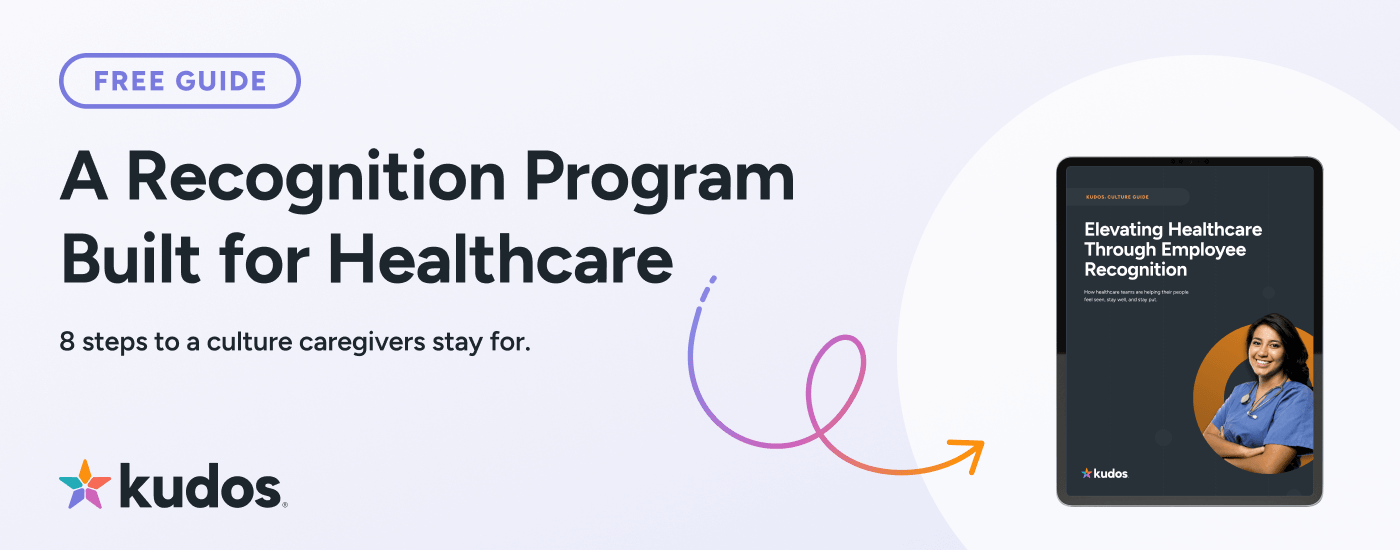
Our new guide, Elevating Healthcare Through Employee Recognition, brings together:
→ Want to build a recognition culture that sticks in healthcare? Download the Kudos Healthcare Culture Guide to get started.
Adrian Jefferson works in service excellence and people development at Kaiser Permanente Health Plan, with a focus on employee recognition, engagement, and service culture. This conversation was part of the People People series by Kudos.