The Megamanager Era: Your Team Scaled. Your Time Didn’t.
Performance
Updated on
March 24, 2026
by
Taryn Hart

X min
Performance
Updated on
March 24, 2026
by
Taryn Hart
X min
Your team got scaled (the average manager now leads ~12.1 direct reports), but your time didn’t. You’ll likely drift into one of three burnout modes (bottleneck, invisible, reactive) unless you reset how you lead.
Stop trying to be available for everything, manage with lightweight systems, like:
If this feels painfully familiar, the fix isn’t more hustle — it’s better systems. And the full Manager’s Playbook gives you the plug-and-play version.
It’s Monday morning. You open your calendar and realize you have six 1:1s back-to-back, a “quick” re-org meeting, two performance issues simmering, and a Slack thread titled “urgent” that started at 6:12 a.m. You’re not failing — your span of control is.
A recent Gallup-backed data point cited in coverage of the “Megamanager” trend shows the average manager now has ~12.1 direct reports (up from ~10.9 the year prior).
If that’s you, here’s the good news: you don’t need a personality transplant or a new productivity app. You need a different operating model — one that works when your team is big, but your time is not.
When your team grows, your management style doesn’t just scale, it shifts. You stop being a coach and start being a human routing system:
And the cost isn’t just time. It's a loss of self-awareness. With more people you can easily miss:
This is when managers start feeling like they’re working all day and still “behind” at the end of it. The work isn’t just tasks: it’s attention, decision-making, firefighting, and people managing.
Most managers drift into one of these patterns — not because they’re bad, but because the system pushes them there.
Everything depends on you to move forward. Decisions slow down. Good people get annoyed. Quiet quitting can arise.
🚨 What it looks like: “I’ll get to it later today” becomes the soundtrack of your week.
You cope by doing the work yourself. You become the best individual contributor on the team, and the team gets less clarity, less coaching, and more chaos.
🚨 What it looks like: You’re always “in the work” and never in front of it.
You don’t lead, you just respond. You’re in constant catch-up mode, and you only surface when something breaks.
🚨 What it looks like: Everything is urgent. Nothing is planned. Everyone is tired.
If you recognize yourself in any of these: welcome! This is megamanaging. And this doesn’t mean you’re a “bad” manager — this is just the norm now.
Manager enablement is the practical support system that helps managers do the job they’re already being asked to do:
In the Megamanager era, it’s not “extra training” or another HR program. It’s tools + guidance + simple routines + permission to focus, so managers can lead consistently (even when time and budgets are tight).
And this matters right now because manager capacity is cracking. When managers are stretched thin, the whole system feels it — clarity slips, recognition becomes sporadic, development gets deprioritized, and issues show up late.
The 2025 Employee Recognition Trends report puts a spotlight on manager enablement as the difference-maker: enablement is how you help managers keep the basics alive at scale — especially when they’re leading 12+ people.
You don’t need more meetings. You need a simpler operating model built for reality. Here are the three decisions that change everything:
Availability feels like good leadership, until it becomes a trap. In the megamanager era, “always available” usually creates:
👉 Try this: Trade “always available” for consistently reliable: clear priorities, a predictable cadence, and a few repeatable routines.
With more people, you can’t rely on intuition alone. You need a few lightweight signals that help you spot issues early (before they become performance problems or resignations.)
👉 Try this: The 3-2-1 Engagement Check is simple: ask 3 questions, collect 2 signals, take 1 action.
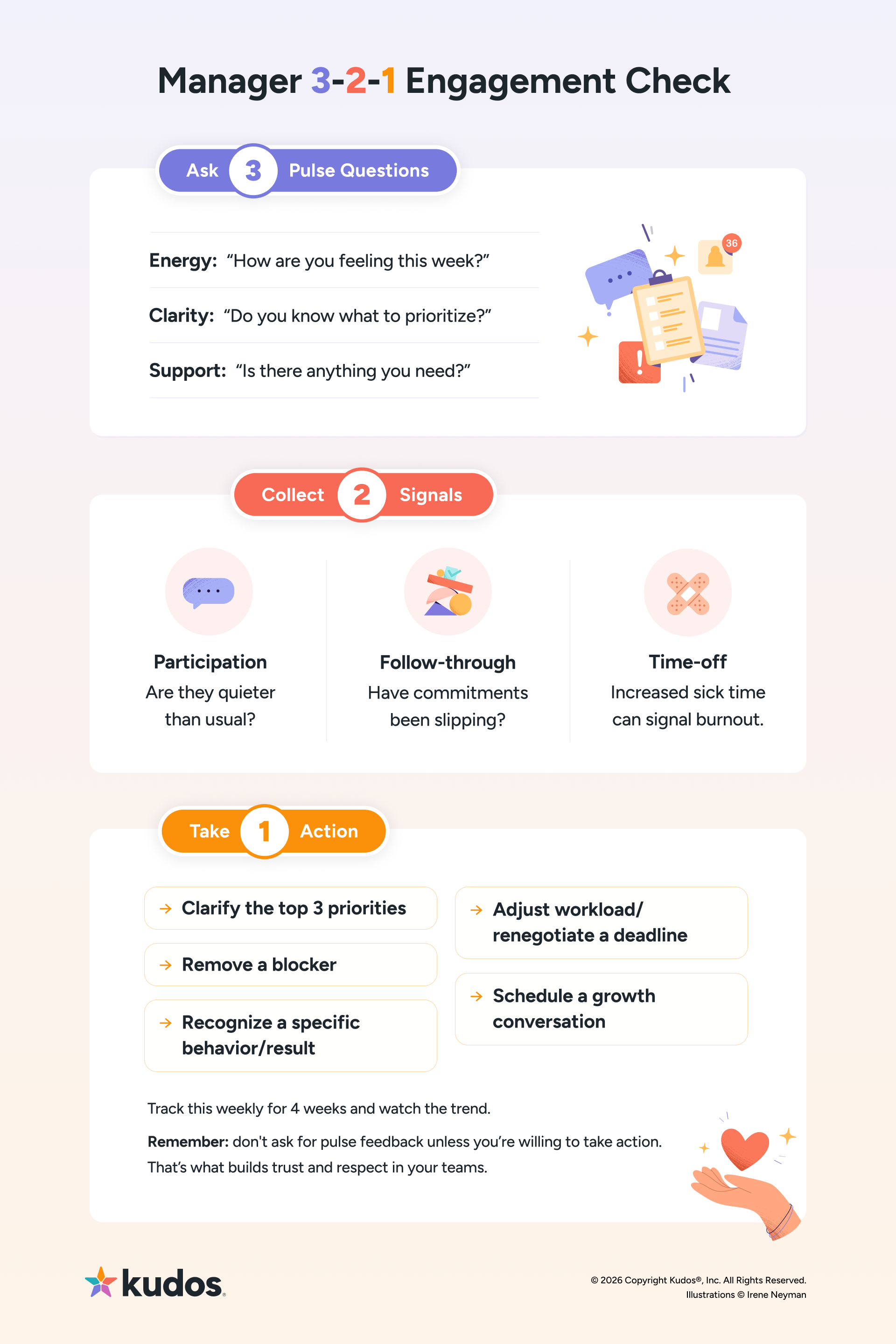
👉 Here’s this 3-2-1 Engagement Check as a PDF for you 👈
You won’t fix disengagement overnight, but you can catch it earlier.
Your team doesn’t need you to be heroic. They need you to be consistent.
👉 Try this: Try a 15-minute weekly rhythm (5 minutes each) to:
It’s small on purpose. Managers with 12+ direct reports can’t afford to spend hours on each of these for every team member.
We know that managers don’t need another “initiative” — they need something they can actually keep doing. Let’s dive deeper into this 15-minute weekly rhythm. 👇
This isn’t about being “nice.” It’s about making the right work visible, so the team knows what “good” looks like.
A simple benchmark: two recognition messages per employee, per month. And to make recognition have an even greater impact, follow this formula: follow this formula:
💡 Also: don’t guess what matters — ask reflective questions in your 1:1s like:
Connection doesn’t happen by accident. It happens when people feel seen, supported, and safe. Consistent check-ins are the fastest way to build that.
A practical check-in structure:
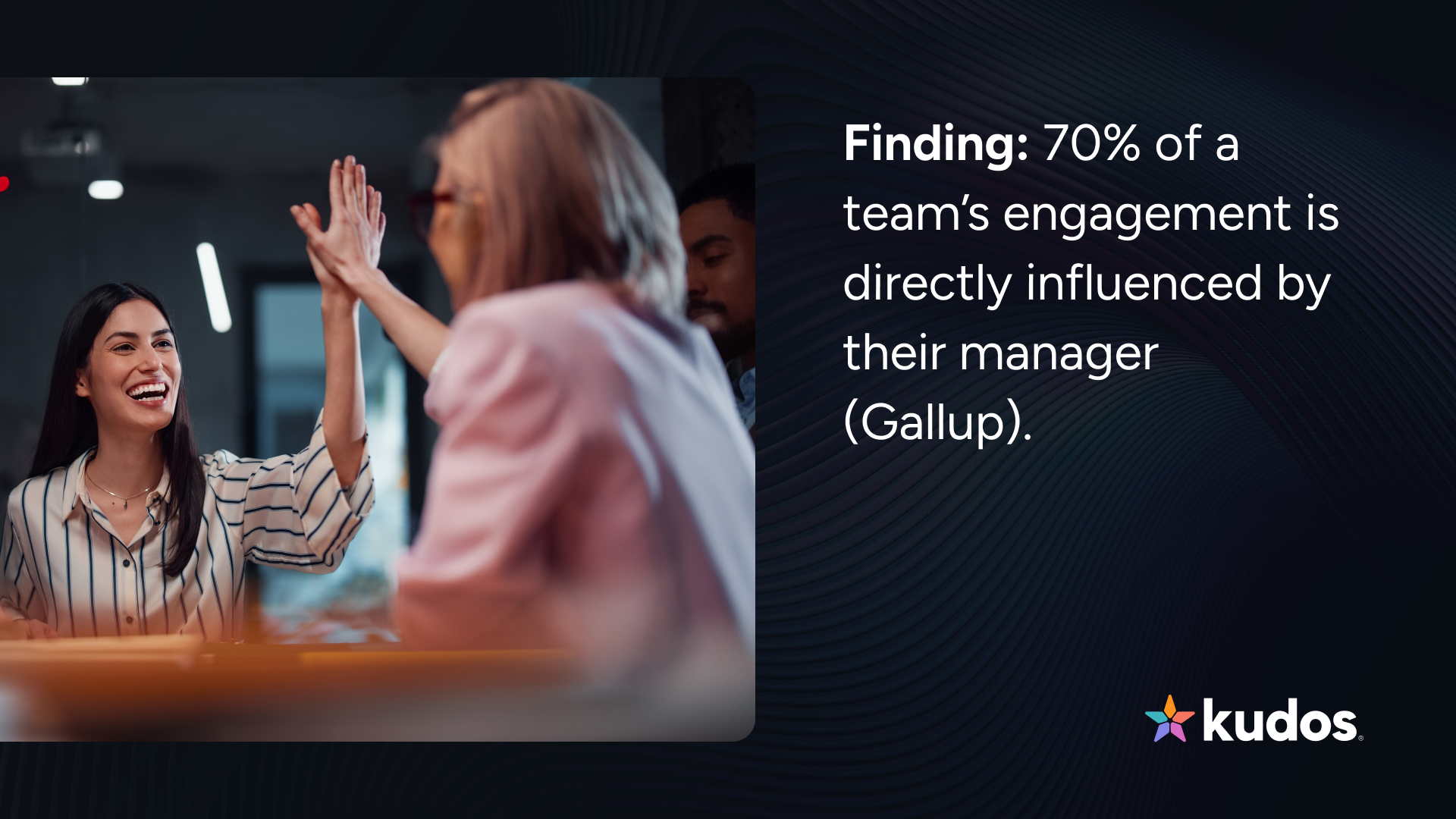
And yes — your influence matters. 70% of a team’s engagement is directly influenced by their manager.
When budgets are tight and people are spread thin, “doing more with less” isn’t the move. The move is putting your limited time where it has the most impact. Start tracking three universal metrics executives care about:
If all of this feels painfully familiar…that’s because it is.
If you’re reading this and thinking, “Yep. That’s me,” here’s the thing: you’re not bad at managing — you’re managing in a setup that wasn’t designed for humans.
Because with 12+ direct reports, the job quietly turns into a never-ending game of whack-a-mole:
And the worst part? You go home feeling like you worked nonstop, but you’re not sure what you moved.
That’s how burnout sneaks in. Not as one dramatic moment, but as a slow erosion of control. You stop leading with intention and start leading by reaction.
This “megamanager era” is defined by more work, more people, more complexity — while resources, time, and budgets stay tight. When that happens, managers default to survival mode.
👉 Here’s the pivot: The goal isn’t to become a superhero manager. The goal is to build a few lightweight habits that protect your time and give your team what they need most: clarity, support, and momentum.
That’s why we keep coming back to “manager enablement” — when managers are supported with simple tools, reminders, and no-cost options, the work becomes a habit instead of another task on the list.
If you’re in the megamanager reality (too many people, too little time), don’t white-knuckle your way through another quarter. Download the complete Manager’s Playbook for the exact routines, prompts, and templates to help you:
The megamanager era doesn’t reward hustle. It rewards systems. And you deserve one that actually works.
👉 Download The Manager’s Playbook for Building High-Performing Teams 👈


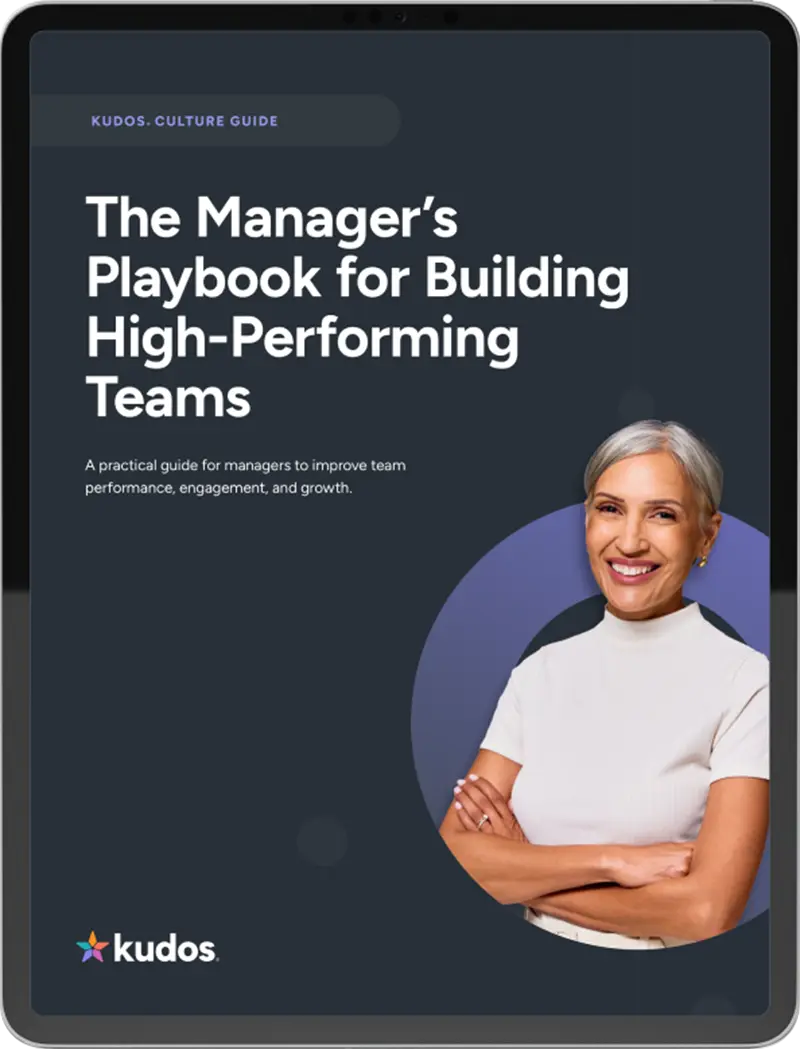
The Manager’s Playbook for Building High-Performing Teams
Get Your Guide