The Science Behind Employee Recognition
Recognition
Updated on
June 4, 2026
by
Taryn Hart

X min
Recognition
Updated on
June 4, 2026
by
Taryn Hart
X min
Recognition is a core requirement in the esteem level of Abraham Maslow's Hierarchy of Needs pyramid. Recognition works because it's both a social reward (belonging, status, connection) and a behavioral reinforcer (people repeat what gets noticed).
When we give and receive gratitude and appreciation, something powerful is happening in our brains:
Receive appreciation → Triggers release of dopamine and serotonin → Activates the rewards center in our brains→ A gratitude circuit is created → Motivational thought patterns increase
Simply put, more recognition = more motivation.
Key takeaways:
Recognition isn’t just a feel-good extra. It’s one of the simplest ways to shape culture because it answers two fundamental questions employees carry every day:
When people feel seen and valued, they’re more likely to contribute, collaborate, and stick around — and we have the science to prove it.
In 1943, Abraham Maslow theorized that human beings are motivated to make decisions based on a hierarchy of needs.
This hierarchy can be viewed as a pyramid, with basic physiological needs (water and food setting the foundation), then our need for safety, love and belonging, esteem, and self-actualization.
And there's core requirement in the esteem level of this pyramid: appreciation.
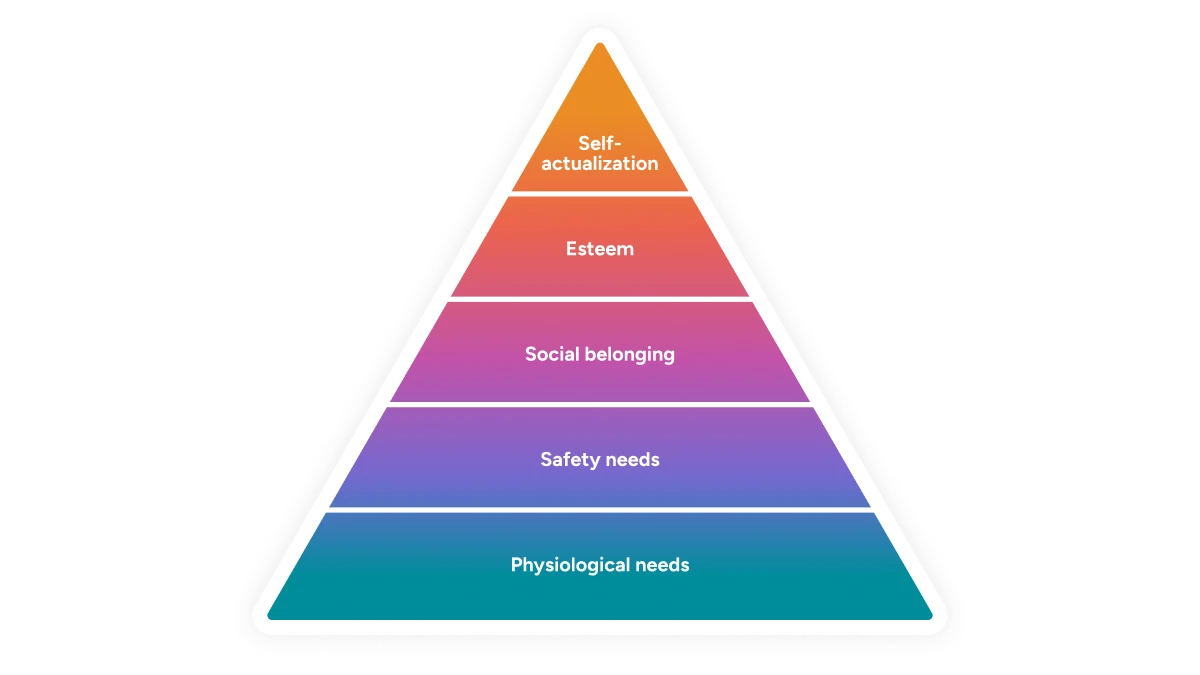
Human beings have a natural need to accomplish things, and then be appreciated and recognized for those accomplishments. In addition to feeling accomplished, we need to know that our contributions to the world are valued.
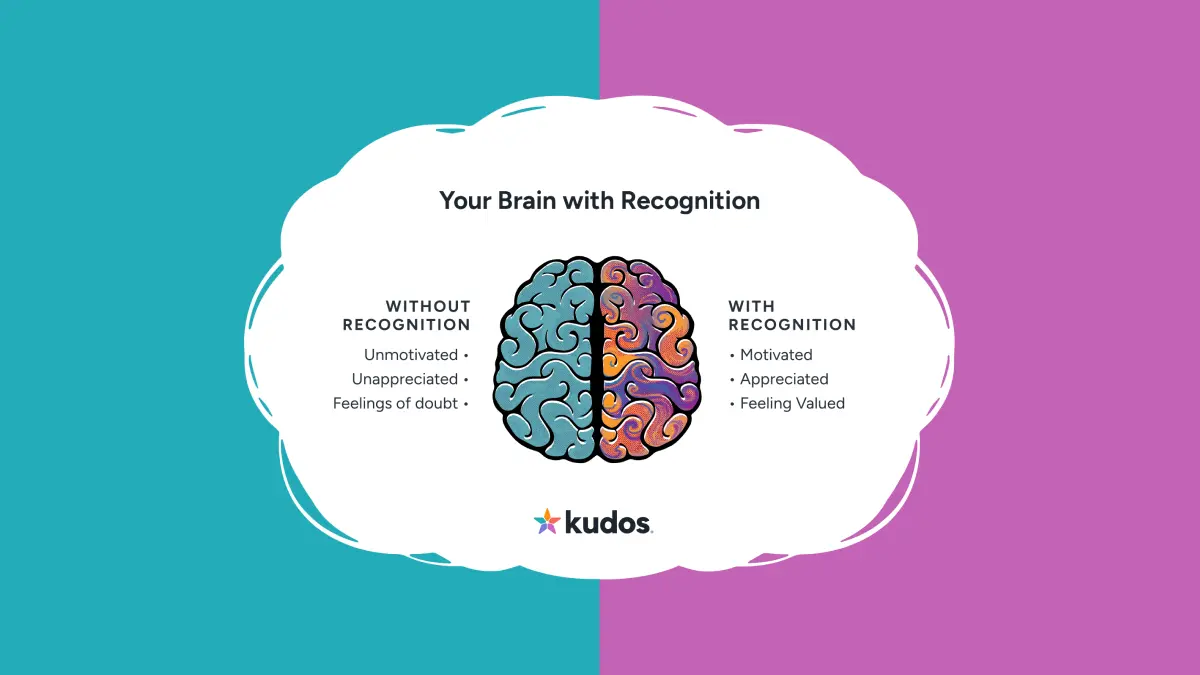
Without this recognition, we begin to feel our hard work has no purpose. And without purpose, we feel unappreciated, undervalued, and unmotivated.
Our brains are wired to crave connection, belonging, and acceptance. When we experience appreciation and gratitude, our brains release dopamine and serotonin.
This is what makes us feel good and gives us the ability to regulate our emotions. Actively experiencing gratitude and appreciation also improves how we manage and respond to stress.
It gets even better than this, though — when we say our thoughts of appreciation out loud, our prefrontal cortex is activated. This is the part of our brain that is responsible for:
The more we practice expressing appreciation, the more we activate these gratitude circuits in our brain. Overtime, it takes less effort to stimulate those pathways.
Scientists also suggest that by activating the reward center of the brain, gratitude exchange alters the way we see the world and ourselves. When we give and receive ‘thank you’ notes, our brain automatically produces motivational thought patterns.
In more simple terms: more recognition = more motivation.
1) Social reward: belonging and status
Humans are wired to care about acceptance and contribution. Recognition signals: “You matter to this group.” That supports connection, trust, and willingness to speak up (critical ingredients for collaboration and psychological safety.)
2) Behavioral reinforcement: what gets recognized gets repeated
Recognition is feedback. When it’s specific (“what you did”) and meaningful (“why it mattered”), it strengthens the likelihood of that behavior happening again, especially when tied to values (e.g., customer focus, ownership, inclusion).
3) Gratitude and the brain (what we can say confidently)
Neuroimaging research has examined brain activation during gratitude-related experiences, including prefrontal activation while receiving gratitude.
For HR leaders, the practical implication is straightforward: recognition that feels authentic and timely can help people feel more connected and motivated to contribute.
Employee recognition promotes positive psychological functioning (PPF) and its absence worsens it. Positive psychological functioning is comprised of the positive feelings that lead to:
The absence of recognition can deteriorate an employee’s psychological health, and ultimately their performance.
Feeling unappreciated affects not only your emotions, but also how you think and act. So, it’s no surprise that a lack of appreciation can drastically influence mental health.
Psychological safety is the shared belief that it’s safe to take interpersonal risks at work (speaking up with ideas, questions, concerns, or mistakes), without fear of punishment or humiliation.
When psychological safety is high, people are more likely to:
Google’s research on team effectiveness (Project Aristotle) popularized psychological safety as a key factor that helps explain why some teams outperform others.
To avoid a common misconception: psychological safety doesn’t mean “no accountability,” “no conflict,” or “lower standards.” It means people can be candid and learn in the open while still being held to high expectations.
Recognition is one of the simplest ways to reinforce psychological safety because it signals:
When recognition is specific, fair, and values-linked, it helps normalize speaking up, sharing credit, and learning. All of which are core behaviors in psychologically safe cultures.
Design recognition as a network (peer + manager + leader), not a single lane. Use this framework to make recognition consistent across the organization:
Peer → peer (cross-functional)
“Thanks for jumping on the client issue within an hour and coordinating the handoff. Your clarity saved us a day of back-and-forth and helped the customer feel supported. This is a great example of ownership.”
Manager → employee (performance + development)
“Your summary in today’s meeting was concise and actionable. It aligned everyone on the decision and reduced rework. Keep leaning into that strength! This is customer focus in action.”
Team lead → team (reinforcing norms)
“Shout-out to the whole team for documenting decisions in the channel this week. It made async collaboration smoother for our remote folks and improved transparency and collaboration!"
Technology now exists to make recognition accessible, simple, and impactful for any organization. Cloud-based platforms that work in browsers and mobile apps allow remote, hybrid, and in-office employees a place to regularly share meaningful recognition (like Kudos!)
Modern workplaces are still under-investing in this. Recognition is one of the few culture practices that is both human and measurable. Plus, it can be designed to reach every employee, not just the most visible.
It’s been almost 80 years since Abraham Maslow theorized that human beings require appreciation. The science behind employee recognition was always there, now it’s time to take it seriously and implement the recognition your employees not only deserve, but need.


The Manager’s Playbook for Building High-Performing Teams
Get Your Guide