How Recognition Drives Employee Engagement in Credit Unions
Engagement
Updated on
September 25, 2026
by
Taryn Hart

X min
Engagement
Updated on
September 25, 2026
by
Taryn Hart
X min
There’s real pressure happening in the credit union sector. More companies are experiencing rapid growth, organizational change and operating under remote or hybrid work models.
These pressures point to the same conclusion: employee engagement isn't something that happens naturally anymore. It must be built. Credit unions that build recognition into daily operations see it hold up exactly when it matters most, like during rapid growth, a system transition, or periods of high stress.
Oregon Community Credit Union is proving that this works: holding a 95.6% employee retention rate, and high recognition satisfaction scores in their annual engagement survey for the last 5+ years.
96% of leaders at credit unions expect their institutions to grow in the next 12 months.
That growth is spread across branches, and often a distributed workforce. The talent market is more competitive than ever, with larger banks pulling from the same pool of people.
This puts real pressure on something credit unions have always done well: keeping employees engaged and connected to the mission.
The good news is that engagement doesn't have to be left to chance. When recognition is built into how a credit union operates, it becomes one of the most reliable ways to keep engagement strong, even as everything else around it changes.
Oregon Community Credit Union (OCCU), a Kudos client since 2021, is living proof that this works. OCCU treats recognition like an ecosystem throughout their entire organization, which is why recognition has been a consistent strength on their engagement survey for 5+ years.
🎥 Watch the webinar recording: A Credit Union's Playbook for Exceptional Culture
Turnover is expensive. Replacing an employee can cost up to 200% of their annual salary once you factor in retraining, lost institutional knowledge, and the morale hit felt by the team left behind.
Competition for talent is fierce, with 61% of financial services workers currently job hunting. And for the Gen Z and Millennial employees who now make up the majority of the workforce, lack of recognition is the second-biggest driver of job-related stress.
Altogether? These pressures point to the same conclusion: engagement isn't something that happens naturally anymore. It must be built.
The first casualty is usually the informal stuff:
None of it was ever written into a process or policy. It just happened, because everyone was close enough, physically, for it to happen. Growth and distance, unfortunately, quietly take that away.
When a credit union grows and starts spreading across new regions, opportunities to keep culture and engagement strong, start to fade. Recognition that depends on physical proximity or in-office moments no longer reaches everyone.
Before landing on dedicated recognition software, OCCU went through a period of trial and error trying to patch the problem with manual programs:
“I do not recommend it to anyone. It was so administratively difficult,” shares Sarena Cook, Human Resources Business Partner at OCCU.
None of these were bad ideas; they just didn't hold up under real conditions.
The thread connecting all of them was the same: it worked okay some of the time, but not consistently across an entire organization spread across branches, remote teams, and multiple states.
That inconsistency is what led them to Kudos. The question of "how do we make sure recognition works exactly the same way for everyone” is hard to answer with ad hoc tools and manual effort.
It's also what separates recognition efforts that fade out from ones that last. Employee recognition software is equitable and scalable enough to survive any change. More importantly, it’s what keeps people connected and engaged through the change.
Engagement stays strong when recognition gets built into the daily rhythm of how the organization runs, instead of being left to good intentions.
Think of it as a drumbeat rather than a special occasion. Frequent, specific, low-effort recognition does more for sustained engagement than one big annual event ever could. The goal is to make sending recognition so normal that it becomes part of how people already interact.
“Once we got a strong footing in bringing people into the system, [recognition] became natural, organic and easy,” shares Russ Kukini, People Engagement Business Partner at OCCU, on their Kudos program.
“One of the things we love doing is opening up the Kudos wall in the morning and seeing what is so natural for our managers now: giving meaningful recognition. And seeing peers recognizing from a cross-department perspective. It's really become something that has grown over time, and now has this incredible life of its own, and we have different ways to engage and try new things.”
One of the most effective ways to build that structure is to connect every act of recognition to a specific organizational value. Instead of a generic "good job," someone selects which value the moment reflects.
This turns a wall of recognition messages into measurable people data. Values stop being words on a wall and start becoming a living, searchable record of how culture shows up day-to-day. Leaders can see, through quantitative data, which values are getting lived out the most — and where the gaps are.
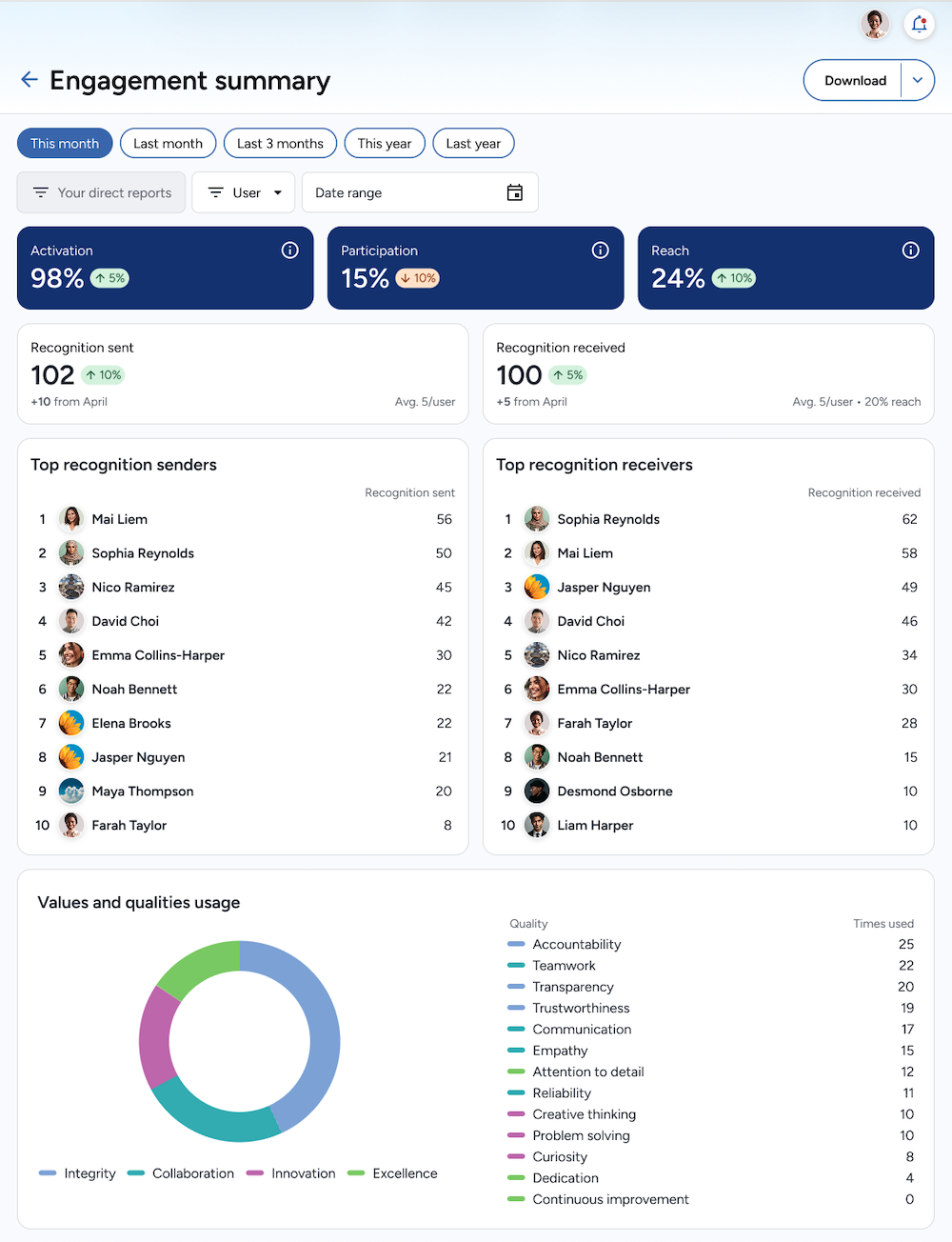
OCCU built their recognition program around three core values (Tenacious, Humble, and Big-Hearted) and ties every recognition message back to one of them. When they ran their first Gallup Q12 engagement survey after building this into their culture, recognition came out as their #1 organizational strength.
Managers help sustain program engagement. Whether recognition sticks or fades usually comes down to whether people leaders are actively modeling that behavior.
❌ However, setting strict quotas (“must send X amount of recognition”) tends to backfire, making recognition feel forced rather than genuine.
What works better is treating recognition data the way you'd treat any other engagement signal:
This is also where engagement surveys earn their keep. A dedicated question about recent recognition like, "have you received recognition or praise for good work in the last seven days?" gives managers a direct, individual signal to act on, rather than a vague organizational mood to guess at.
The Kudos 2026 Recognition Impact Report proves measurable return on investment for recognition in the workplace. For credit unions making the case to a board or a CFO, the data is on your side.
→ 91% of leaders say recognition through Kudos is aligned through their company values
→ 60% of employees feel more appreciated for their contributions
→ 51% of employees say recognition improves their sense of belonging and inclusion
For credit unions, these numbers also translate directly to your member experience. Your member experience strategy and your employee recognition strategy aren't separate programs. They're the same program, viewed from different angles.
Recognition is one of the most direct investments you can make in the sustainability of that experience.
The business case follows naturally. OCCU, for example, has sustained a 95.6% employee retention rate alongside 100% platform participation in their Kudos program.
“We started with a really solid foundation, but one of the things that our partnership with Kudos offered was the ability to integrate that already strong foundation into so many different aspects of the work that we do,” explains Kirsten Simmons, Senior Vice President of People Development at OCCU.
👉 Read OCCU’s full case study for more business results and impact


Building a Winning Talent Strategy Through Irresistible Culture
Get Your Guide